

I’ve reached an age where I cannot believe some of the things we used to do that were considered normal.
And no, I’m not talking about the overused cliché of drinking out of a garden hose. I really wish we could let that one go. I’m pretty sure kids today still drink out of hoses, and kids before us did too. It’s not exactly a generational badge of honor.
No, I’m talking about navigating around town – or even taking a road trip – without GPS.
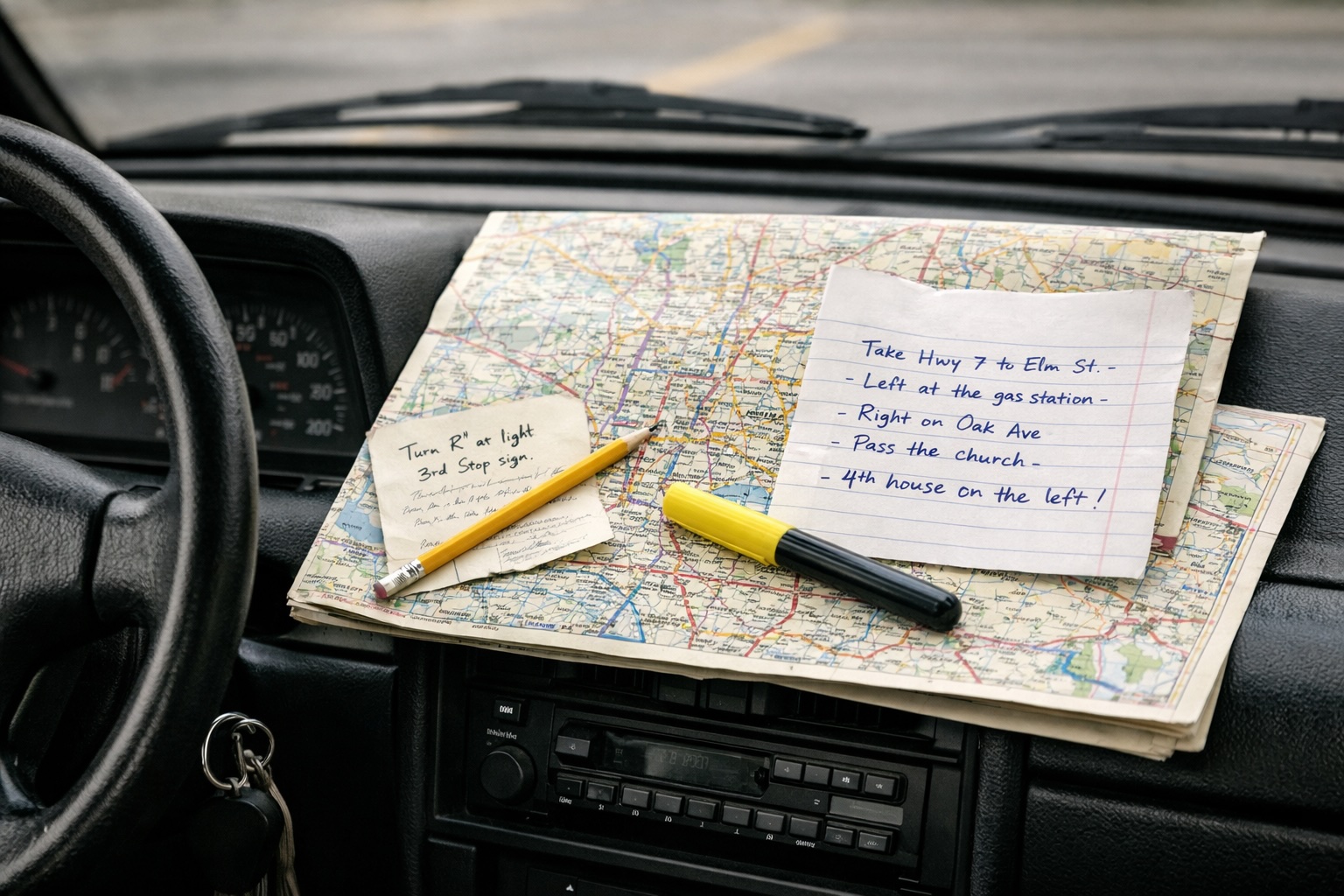
I can’t even understand how we did it in the 90s and early 2000s with MapQuest. Printing directions like we were preparing our taxes and the first three pages were just getting out of the neighborhood.
Before that, we used maps. Actual folded maps. Every car had one jammed in the glove compartment, usually half-torn and never folded correctly again. Or we just… knew how to get there.
When I learned how to drive, there was a stretch of 35E that didn’t exist yet. Construction had been halted because the mothers in my neighborhood didn’t want to hear highway noise at night. Which, in hindsight, is both incredible and completely believable. These were the OG Karens.
I spent my winter youth sledding down the embankment that is now a major highway. That’s a much better story than drinking out of a hose.
I don’t remember how long construction was stopped – several years, maybe longer – but I do remember when it finally opened. Suddenly the southern metro area was easy to access. Before that, we slithered through downtown or navigated side streets past the airport to get to the baseball stadium.
Which is now the Mall of America.
And yes, I understand things change.
The problem is, I still take the routes I learned before the freeway was completed, because those are the routes I know.
I’m reminded of something my theater professor, the late Arthur Ballet, once said:
“People know what they like, and they like what they know.”
He meant it in regards to art, but it applies to everything.
Familiarity might breed contempt, but it also means we get to our destination, and on time.
I don’t remember using maps much when I first started driving around the city. I just knew where to go. Not the fastest route – definitely not the most efficient route – but I got there. Both of my ex-husbands were happy to point out there were much better ways to reach literally anywhere I was going.
If we needed directions, they were scribbled on a piece of paper. They included landmarks – the red barn, the gas station, the elm tree that got hit by lightning. If we got lost, we pulled over and asked a stranger.
Because we didn’t have cell phones to call someone.
We’d also do a lot of guessing.
“It should be around here” was a perfectly acceptable navigation strategy. We’d turn early, turn too late, circle the block, and occasionally just commit to a direction that ‘felt right’ and hope for the best. Most of the time we found what we were looking for. The other times we discovered a Dairy Queen, which seems like a solid win in hindsight.
Driving in Minneapolis was easier because it was on a grid and the streets were alphabetical and numbered. In St. Paul there was no grid and no rhyme or reason to the street names. You just had to know where you were going.
Which is why all of us could determine which direction was North by a very young age.
We also had this thing called the phone book. It was dropped on the doorstep every July. Everyone got one. The white pages for people. The yellow pages for businesses.
New phone books were exciting. The Jerk nailed that moment perfectly. When I got my first apartment and had my own listing, I felt just like Navin Johnson.
Before that, we’d flip through the phone book looking up cute boys’ addresses and phone numbers, even though we rarely gathered the courage to actually talk to the boys. Before caller ID, we’d dial, wait for them to answer, then hang up and giggle for five minutes. Of course, we also had their addresses, so we could always just drive by their house and hope to catch a glimpse of them tossing a ball or doing yard work.
And when hang up calls got too nerve-wracking, we looked up pizza — 30 minutes or it’s free. And it was rarely free because those drivers knew their way around the city.
If you didn’t want your number listed, you had to pay extra. Now it’s the opposite.
We memorized phone numbers. Lots of them. We didn’t need area codes, and we dialed every call manually, which gave those numbers time to settle into long-term memory. My best friend. My dad’s office. The local pool. The neighborhood drugstore. My grandparents. Even the long-distance ones.
Long distance – there’s a generation or two of humans who have no idea what that means.
It used to cost real money to call my grandparents in Ohio, so we called once a week, when we were sure they’d be home. The calls were short. We had to learn from an early age the art of brevity.
We also cooked. Every night. Every morning. Going out to eat was rare and a treat. Dinner was at the same time each night, with a reliable weekly menu. And we ate together.
I miss that.
I don’t want to give up my GPS. And I can barely survive a two-mile walk when I realize I forgot my phone.
But I do miss the connection that all these gadgets replaced.
And I think we need some of that back.


Leave A Comment