

You don’t have to agree with someone to think they’re worth listening to.
That sounds obvious, but judging by the current state of social media, it apparently isn’t.
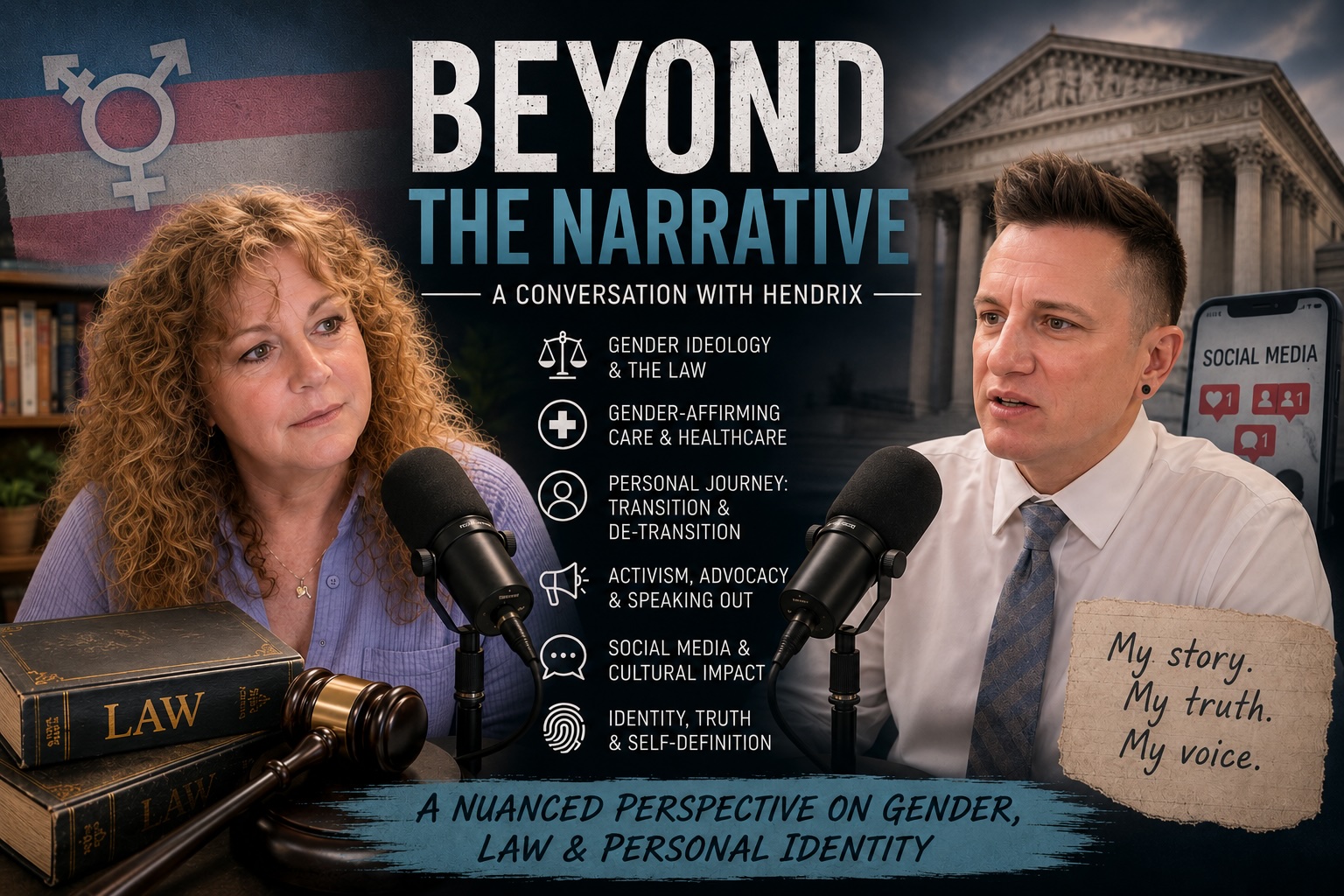
I recently sat down with Hendrix for a long-form conversation about gender ideology, activism, transition and de-transition, social media, and the increasingly complicated legal and cultural landscape surrounding all of it. Hendrix is a former trans man, attorney, and advocate who now speaks publicly about the experience of transition, de-transition, and what it feels like to question beliefs that once shaped your entire identity.
It was not a screaming match. Nobody flipped a table. No one called for anyone to be canceled. Which in 2026 almost qualifies as groundbreaking content.
What struck me most during the conversation wasn’t outrage or politics. It was how much of modern life now revolves around identity, performance, and public approval. Social media has turned deeply personal experiences into movements, movements into brands, and brands into tribal warfare.
Once that happens, it becomes very difficult for anyone to say, “Actually, I’m not sure anymore.”
That uncertainty is what interested me.
Not because I think every person’s experience is the same, but because we’ve created an environment where nuance itself feels dangerous. You’re expected to pick a side immediately, repeat approved language, and stay inside the lines. If you don’t, people start looking at you like you just tracked mud across the living room carpet.
Hendrix talked openly about the emotional side of transition and de-transition, but also about the legal and cultural pressures surrounding gender ideology, healthcare, online activism, and public discourse. Some people will hear the interview and agree completely. Others won’t agree with any of it.
That’s fine.
The point of conversations like this isn’t universal agreement. It’s understanding how we got here and why so many people are struggling to talk honestly about complicated issues without immediately trying to destroy each other.
One thing I’ve noticed over the last several years is that social media rewards certainty, outrage, and performance far more than reflection. Algorithms do not care about nuance. Nuance doesn’t trend. Thoughtful people rarely go viral because thoughtful people tend to pause before speaking, and the internet prefers immediate emotional reactions delivered in all caps.
That creates a problem when discussing deeply personal topics involving identity, medicine, law, and culture. Real life is messy. Human beings are messy. But online discourse demands clean slogans and absolute certainty.
And honestly, I think a lot of people are exhausted by it.
You can feel it everywhere now. People are afraid to ask questions. Afraid to say they’ve changed their minds. Afraid to admit confusion. Afraid that one wrong sentence will follow them forever. We’ve built a culture where public opinion can shift overnight, but screenshots are eternal.
The interview with Hendrix touches on all of that.
Not as a political debate staged for clicks, but as a real conversation between two people trying to make sense of a rapidly changing world that increasingly demands ideological loyalty from everyone involved.
Whether you agree with Hendrix or not, I think there’s value in hearing firsthand experiences directly from the people who lived them instead of filtering everything through headlines, activists, corporations, or social media outrage cycles.
At minimum, it reminds us that behind every cultural battle are actual human beings trying to figure themselves out in public while millions of strangers weigh in from the comment section.
Which honestly sounds horrifying.
You can watch/listen to the full interview below. I’d encourage people to approach it with curiosity instead of combativeness, which I realize is basically asking the internet to do the impossible at this point.
You can watch/listen to the full interview below. I’d encourage people to approach it with curiosity instead of combativeness, which I realize is basically asking the internet to do the impossible at this point.



Leave A Comment